

Table of Contents
- Why Muscle Tension Builds Up (And Why It Keeps Coming Back)
- Best Neck Massager for Office Workers: What Actually Helps
- How to Use a Massage Gun for Tension Without Making It Worse
- Ergonomic Workspace Setup for Muscle Relief That You Can Do Today
- Heat, Acupressure and Cupping: Non-Invasive Tools Worth Trying
- Stress, Sleep and Magnesium: The Recovery Side Most People Skip
- When to See a Physiotherapist Instead of Self-Treating
- Conclusion
- Frequently Asked Questions
Last Updated: September 16, 2026
Why Muscle Tension Builds Up (And Why It Keeps Coming Back)
Muscle tension is a sustained contraction of muscle fibres that persists after the triggering movement or stress has passed. It builds up through prolonged static posture, psychological stress, dehydration, and poor sleep, and returns because those drivers are rarely addressed.

Best Neck Massager for Office Workers: What Actually Helps
The best neck massager for office workers fits into a working day without disruption, targets the neck and upper trapezius, and works in short sessions between tasks. For most desk roles, that means a percussion massager with a quiet motor and interchangeable heads, not a bulky chair-mounted unit.

What to Look For Before You Buy
Four specifications decide whether a neck massager gets used or ends up in a drawer:
- Noise level. An office rules out anything loud. Look for a motor rated under 45dB, roughly a quiet conversation.
- Head variety. A ball head suits broad shoulder work; a fork or bullet head reaches the neck's paraspinal muscles. Fewer than four heads limits what you can treat.
- Speed range. Variable speeds let you start gentle on a sensitive neck and increase pressure on the upper back. A single-speed device is a blunt instrument.
- Battery life. If it needs charging every other day, it will not survive a working week. Aim for several hours per charge.
How to Use a Massage Gun for Tension Without Making It Worse
Used correctly, a massage gun releases tight tissue and improves circulation. Used badly, it bruises muscle, irritates nerves, and worsens tension. The difference is pressure, duration, and head placement.
Step-by-Step: A Five-Minute Neck and Shoulder Routine
- Warm the tissue first (1 minute). Lowest speed, gliding over the upper trapezius and shoulder blades. No pressure yet, just movement.
- Work the upper trapezius (90 seconds). Medium speed, moving slowly along the muscle between neck and shoulder. Pause on tight bands for a few seconds, then keep moving.
- Treat the shoulder blade border (90 seconds). Angle the gun so the head sits on muscle around the shoulder blade, never on bone. This is where desk workers hold most tension.
- Finish on the neck's base (60 seconds). Lowest speed, working the muscles either side of the spine at the base of the neck. Keep the head supported and relaxed.
- Stretch afterwards (30 seconds). Tilt the ear towards the shoulder and hold. Releasing tissue without stretching it leaves the muscle short.
Ergonomic Workspace Setup for Muscle Relief That You Can Do Today
Ergonomic workspace setup for muscle relief starts with three measurements: screen top at eye level, elbows at roughly 90 degrees, and feet flat on the floor. Get those right and you remove the static load that keeps neck and shoulder muscles contracted all day.
A practical setup checklist:
- Screen top level with your eyebrows, roughly an arm's length away
- Chair back supporting the natural curve of the lower spine
- Wrists straight, not bent up or down, when typing
- Feet supported, with hips slightly higher than knees
- Phone raised or held, never cradled against the shoulder
Heat, Acupressure and Cupping: Non-Invasive Tools Worth Trying
Non-invasive tools work best when matched to your type of tension and stage of recovery. The mistake most people make is treating them as interchangeable, reaching for whatever is nearest rather than the tool that suits the tissue. Heat, acupressure, cupping, TENS, and trigger-point tools each do something different, and the wrong one at the wrong time can slow recovery.
Match the Tool to the Tissue
| Tool | Best For | Typical Session | Mechanism | Where It Falls Short |
|---|---|---|---|---|
| Far infrared heating pad | Chronic stiffness, deep ache, pre-stretch warm-up | 15-20 minutes | Infrared wavelengths penetrate deeper than surface heat, increasing local blood flow and tissue extensibility | Not for acute swelling, fresh injury, or numb skin |
| Moist heat (hot towel, wheat bag) | General stiffness, low-cost option | 10-15 minutes | Surface warming, mainly comfort and short-term ease | Shallow penetration; needs reheating |
| Acupressure mat | Stress-driven tension, wind-down before sleep | 10-20 minutes | Pressure points plus lying still; the relaxation response does much of the work | Uncomfortable for the first few uses; not for acute pain |
| Silicone cupping set | Trigger points, stubborn knots, dense bands | 5-10 minutes per area | Negative pressure lifts tissue and increases local circulation | Leaves temporary marks; avoid on thin or fragile skin |
| TENS machine | Pain signal interruption, working through a flare | 20-30 minutes | Electrical pulses gate pain signals at the spinal cord | Masks pain without releasing tissue; not a fix |
| Trigger point stick or ball | Calves, hamstrings, glutes, IT bands | 1-2 minutes per spot | Sustained pressure on a taut band | Hard to reach the upper back alone |
Sequencing Matters More Than the Tool
The order you use these in changes the result. A reliable pattern for chronic desk-related tightness:

- Warm first. 10-15 minutes of heat before any stretching or self-massage. Warm tissue lengthens further and tolerates pressure better.
- Release second. Acupressure, cupping, or a trigger-point tool on the specific tight band. Keep sessions short, two minutes per spot is plenty.
- Move third. Stretch or move the muscle through its range while still warm. This is where the length gain is consolidated.
- Cool down and rest. Let the tissue settle. Do not stack three tools on the same area in one session.
Heat: The Most Reliable Starting Point
Far infrared pads penetrate deeper than surface heat, reaching muscle and joint tissue rather than just warming the skin, which is why they tend to work better than a hot water bottle for chronic, deep-seated stiffness. The trade-off is cost and a power source; a wheat bag is cheaper and portable but shallower.
Acupressure and Cupping: For Knots, Not Stiffness
Acupressure mats and cupping both target trigger points, the dense, tender bands under the skin. Acupressure applies sustained positive pressure; cupping applies negative pressure that lifts tissue. Both increase local circulation and feel intense at first.
TENS: Useful, But Understand What It Does
A TENS machine interrupts pain signalling, it does not release tight tissue. That makes it useful for getting through a working day when a muscle is guarded and sore, but it is not a treatment for the underlying tension. Use it as a bridge, not a solution, and do not leave it running for hours.
What These Tools Cannot Do
None of them change the posture, workload, stress, or sleep that created the tension. They make movement possible and reduce discomfort in the moment, valuable, but the middle of the routine, not the whole of it. Pair them with the ergonomic and recovery changes elsewhere in this guide and the effect compounds; use them alone and you will be back where you started within a week.
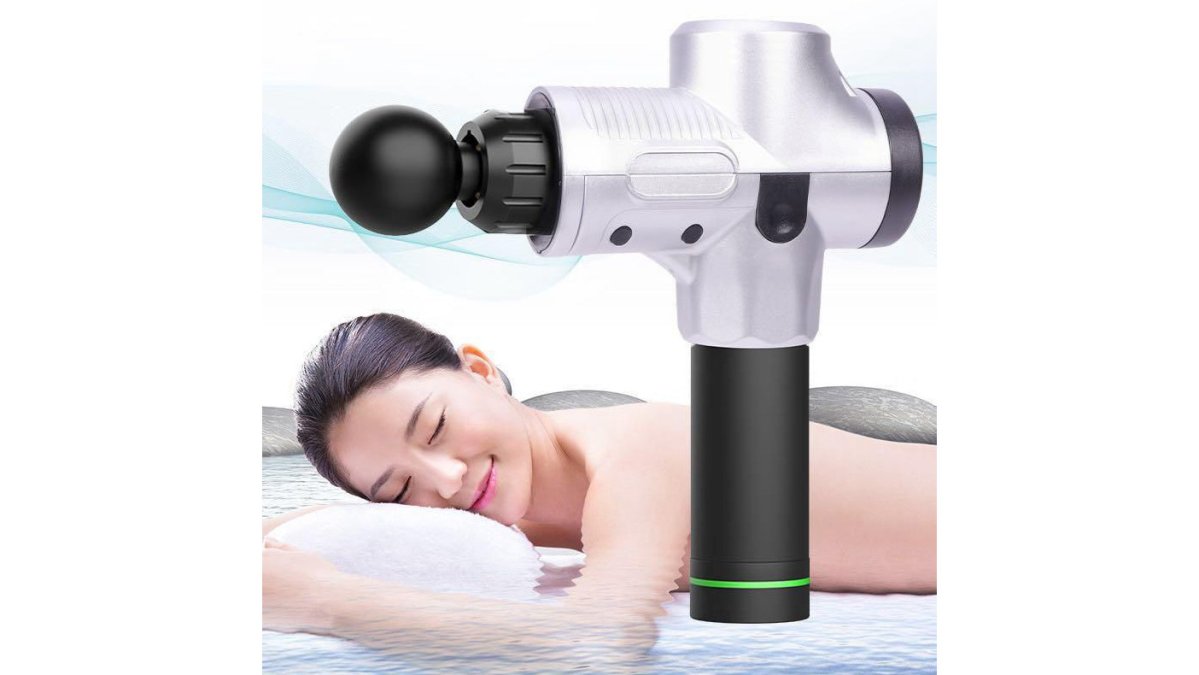
Pro Massage Gun Deep Tissue Percussion →
Stress, Sleep and Magnesium: The Recovery Side Most People Skip
Most guides treat muscle tension as a mechanical problem: tight tissue, bad posture, too much sitting. That is only half the picture. A large share of persistent neck, jaw, and shoulder tightness is psychosomatic, driven by the nervous system rather than physical overload. Understanding that mechanism separates a routine that works from one that keeps failing.
How Stress Keeps Muscles Switched On
When the brain perceives a threat, a deadline, a difficult conversation, a full inbox, the sympathetic nervous system releases adrenaline and cortisol. Muscles in the neck, jaw, and upper back receive a low-level contraction signal as part of the classic "guard" response. Useful for a few minutes, it becomes a problem when the stressor is chronic, because the muscle never receives the all-clear to relax.
Down-Regulating the Nervous System (Not Just the Muscle)
What actually shifts stress-driven tension is anything that moves the body out of sympathetic dominance into parasympathetic rest. Effective options include:
- Slow diaphragmatic breathing. Roughly six breaths per minute, exhale longer than inhale. This stimulates the vagus nerve and lowers sympathetic tone. Five minutes, twice a day, is a realistic starting dose.
- Progressive muscle relaxation. Tense a muscle group for five seconds, then release for ten, working from feet to face. This teaches the nervous system what "relaxed" feels like, many people with chronic tension have lost that reference point.
- Guided body scan or mindfulness practice. Ten minutes daily may help reduce perceived tension.
- Regular aerobic movement. Regular aerobic movement, such as a brisk 20-30 minute walk most days, may help lower circulating cortisol and support relief from stress-driven tightness.
Sleep: Where Muscle Actually Repairs
Deep sleep is when the body clears metabolic waste from muscle tissue, restores glycogen, and completes most repair work. Short or fragmented sleep leaves muscles unable to recover from ordinary daily load, so tension accumulates rather than resetting overnight.
- Consistent wake time, seven days a week, is more powerful than a consistent bedtime.
- A cool, dark room, most adults sleep best between roughly 16-19°C.
- No caffeine after early afternoon; its half-life is long enough to fragment sleep even when you fall asleep fine.
- Screens off for the last 30-60 minutes where possible, or at minimum dimmed and held further from the face.
Magnesium, Electrolytes and Hydration
Magnesium. Involved in muscle contraction and relaxation, and commonly under-consumed. Magnesium glycinate is well absorbed and gentle on the stomach. Food sources, leafy greens, nuts, seeds, wholegrains, legumes, come first, with supplementation as a top-up rather than a fix.
When to See a Physiotherapist Instead of Self-Treating
See a physiotherapist if tension persists, if you experience numbness, tingling, or weakness in the arm or hand, or if pain wakes you at night.
Conclusion
Muscle tension that keeps returning signals that the cause is still in place. The fix is rarely a single product; it is a routine that releases tight tissue, corrects the setup that creates it, and supports recovery through sleep, hydration, and stress management. That is the approach behind the recovery range at Indira Enterprises Ltd, from percussion massage guns and far infrared heating pads to acupressure sets and magnesium glycinate.

Frequently Asked Questions
How do I stop subconsciously tensing my muscles?
Start by noticing when it happens. Set a timer to go off every hour and do a quick body scan: drop your shoulders, unclench your jaw, and check your grip on the mouse. Progressive muscle relaxation, where you tense a group for five seconds then release for ten, teaches your nervous system what 'relaxed' actually feels like. Pair that with a few slow breaths and the habit starts to break within a couple of weeks.
Are there innovative gadgets that help with muscle tightness?
Yes, and several are genuinely useful. Percussion massage guns deliver rapid pulses into deep tissue, which helps loosen stiff areas and improve circulation. A dual channel TENS machine blocks pain signals and stimulates endorphin release across two areas at once. Far infrared heating pads penetrate 3 to 5cm deeper than standard heat pads, reaching muscles and joints directly. Silicone cupping sets and acupressure mats are lower-cost options that work on the same principle of stimulating blood flow to tight spots.
What role does ergonomics play in reducing muscle tension?
A poorly set up desk forces your neck and shoulders into positions they cannot hold comfortably for eight hours. Raise your monitor so the top third sits at eye level, keep your elbows at roughly 90 degrees, and support your lower back so you are not leaning forward. Feet flat on the floor. These changes reduce the static load on your neck and shoulders, which is often the difference between mild stiffness and a knot that will not shift.
How does progressive muscle relaxation compare to physical therapy tools?
They work on different parts of the problem. Progressive muscle relaxation retrains your nervous system to recognise and release tension, which helps with stress-driven tightness that no amount of massage will fix. Physical tools like massage guns, TENS machines and cupping address the tissue itself. Most people get the best result using both: a tool to release what has already tightened, and a relaxation practice to stop it rebuilding overnight.



Leave a comment
This site is protected by hCaptcha and the hCaptcha Privacy Policy and Terms of Service apply.